

Your shopping cart is empty!
 Call us: +1-(437)-290-7537
Cisco vs Juniper vs Arista Switches: Which Is Right for Your Business Network?
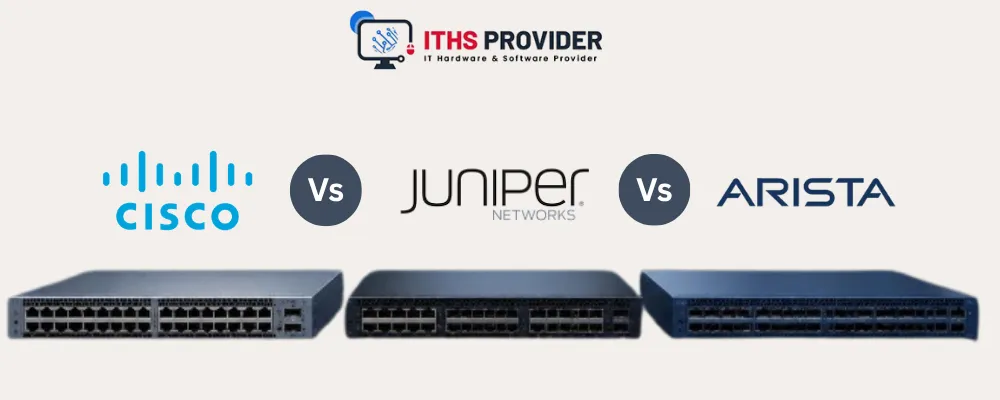
Cisco, Juniper, and Arista are the three vendors IT teams compare most often when planning a switch refresh or a data center build. Cisco offers the broadest product line and the largest talent pool, Juniper runs one operating system across its entire portfolio, and Arista is built specifically for data center and cloud-scale networks with an API-first design.
None of that tells you which one to buy, though. Choosing a switch vendor isn't really a hardware decision. It's a commitment to a certain command-line syntax, a certain automation model, and a certain licensing structure that your team will live with for the better part of a decade. Get it wrong and you're not just stuck with the wrong box in a rack, you're stuck retraining staff or paying for a migration project down the line.
All three sit in the leaders' bracket of enterprise switching, and each one solves the same basic problem differently. This guide breaks down what separates them, where each one fits best, and how to think through the decision for your own network instead of just picking whichever name you've heard the most.
Quick Differences at a Glance
Cisco: Widest product range and the deepest bench of trained engineers. Runs IOS XE on Catalyst switches and NX-OS on Nexus switches, so campus and data center hardware don't share one operating system.
Juniper: Junos runs across the entire switching and routing lineup, so skills learned on one Juniper platform carry over to every other one. Config commits are transactional, meaning a change either fully applies or fully rolls back.
Arista: Built around EOS, a single software image across the whole hardware line, with data center telemetry and automation (gNMI, OpenConfig) included rather than sold as add-ons.
Licensing: Cisco splits perpetual and subscription tiers, which can add up over a few years. Juniper and Arista licensing tends to be more predictable and, in Arista's case, more features ship in the base cost.
Best general fit: Cisco for campus and enterprise, Juniper for multi-platform consistency, Arista for data center and cloud-scale builds.
Cisco Switches for Business Networks
Catalyst 9000 Series (Campus and Enterprise)
Cisco's Catalyst 9000 family is the backbone of its current campus and enterprise lineup, running IOS XE across the range. According to Cisco's own Catalyst 9000 overview, the family is built around a common hardware and software architecture designed to scale with intent-based networking features managed through Cisco's Catalyst Center controller. The Catalyst 9300, for example, is built for stacking and mid-to-large campus deployments, with up to 1 Tbps of stacking bandwidth and support for high-density PoE, which is useful if your office has moved toward more device-heavy, hybrid-work setups.
Nexus 9000 Series (Data Center)
For the data center specifically, Cisco's answer is the Nexus 9000 line, running NX-OS instead of IOS XE. That's worth flagging early: Cisco doesn't run one operating system across its whole portfolio the way Juniper and Arista do. A network engineer comfortable with Catalyst switches will still need to pick up NX-OS syntax and behavior before they're fully productive on Nexus hardware.
Where the Licensing Cost Adds Up
Cisco's biggest practical drawback isn't the hardware, it's the software licensing model. Per Cisco's Catalyst 9300 data sheet, the platform separates a perpetual network license from subscription-based Catalyst and DNA licensing tiers. Depending on which features you actually need, the subscription cost on a fully-licensed switch can rival the price of the hardware itself over a few years. That's not a dealbreaker, but it's a number worth modeling out before you commit to a large Cisco rollout, not after.
Juniper Switches for Business Networks
EX Series (Access and Campus)
Juniper's EX Series covers access and aggregation layer needs. Models like the EX4300 offer strong PoE support and Virtual Chassis technology, which lets several physical switches operate and get managed as one logical device. It's a handy way to simplify management across a multi-closet campus without piling on operational complexity.
QFX Series (Data Center)
On the data center side, Juniper's QFX platforms, including the QFX5100 Series, extend that same Junos consistency into higher-throughput leaf and spine roles, with support for EVPN-VXLAN fabrics in modern data center designs.
Why Junos Consistency Matters
The real differentiator for Juniper isn't any single feature, it's that Junos runs the same way across EX access switches, QFX data center switches, and MX core routers, as Juniper's own EX Series page describes. An engineer who's comfortable configuring an EX3400 in a branch closet already understands the command structure on a QFX10000 spine switch. Configuration commits are also transactional in Junos: a change either fully applies or fully rolls back, which removes a whole category of partial-configuration mistakes that can trip up other platforms.
Arista Switches for Business Networks
7000 Series Family
Arista's switch portfolio centers on its 7000 Series family, spanning compact access-layer models up through high-capacity spine platforms like the 7050X Series. These are built specifically for leaf-spine data center architectures, with solid EVPN-VXLAN support for scalable, segmented fabrics.
EOS and CloudVision
What sets Arista apart is EOS, its Extensible Operating System, which runs as a single software image across the entire hardware portfolio. Per Arista's own documentation on EOS telemetry, the platform ships with streaming telemetry, gNMI and OpenConfig support, and native automation integrations built in rather than sold as add-on licenses. CloudVision then layers fabric-wide visibility and change management on top, giving ops teams one point of control across the environment.
Where Arista's Data-Center Focus Shows
Arista's tradeoff is scope. It's strong in the data center, but its footprint in general campus networking is limited next to Cisco or Juniper. If your project is a data center build or refresh, Arista deserves serious consideration. If you're outfitting office floors and branch closets, though, it's usually not the first name to reach for.
Head-to-Head Comparison
|
|
|
|
|
|
|
|
|
|
|
|
|
|
|
|
|
|
|
|
|
|
|
|
|
|
|
|
|
|
|
|
|
|
|
Cisco, Juniper, and Arista currently sit in the Leaders quadrant of Gartner's Magic Quadrant for data center switching, so none of the three is a risky or unproven pick at the vendor level. The decision comes down to fit, not vendor viability.
Choosing by Use Case
Small business campus refresh: Cisco Catalyst 9200 or 9300 series switches are the safest default here, given the size of the talent pool and the amount of documentation and third-party support around them. If budget is tight, refurbished units from the same generation deliver the same capability at a lower entry cost.
Mid-size branch or multi-site business: Juniper's EX Series is worth serious consideration if you expect to add QFX data center switches or MX routers down the line, since the shared Junos experience keeps training and operations simpler as the network grows.
New data center build: Arista's 7000 Series is a strong in-stock option for teams that want an API-first automation model out of the box.
Existing single-vendor shop standardizing further: Staying within your current vendor's ecosystem usually outweighs any marginal technical edge a competitor might offer, since retraining and revalidating compatibility carries its own real cost.
Automation-first environment: Arista and Juniper both offer stronger out-of-the-box automation than Cisco's Catalyst line, with Arista generally seen as the most API-native of the three.
Budget-conscious campus deployment: If none of the three fits the budget, HPE's Aruba switches are worth a look as a fourth option, particularly in wireless-first environments.
New vs Refurbished: A Practical Cost Lever Across All Three Brands
One thing that rarely comes up in vendor comparisons is that the new-versus-refurbished decision applies just as much to Cisco, Juniper, and Arista alike. A tested refurbished switch runs the exact same firmware and supports the same feature set as a new unit from the same hardware generation. The software licensing model, not the physical hardware, is usually what differs between conditions. Once you've settled on a vendor and product tier, buying refurbished is often the single biggest lever for cutting project cost without giving up any capability the newer unit would have offered.
Support & Guidance
Frequently Asked Questions
Straight answers on choosing between Cisco, Juniper, and Arista switches — and where refurbished hardware fits in.
01 Which is better, Cisco or Juniper switches?
Neither is universally better. It depends on the environment. Cisco has the largest installed base and the deepest talent pool, which matters for hiring and support. Juniper's advantage is that Junos runs consistently across its whole product line, which appeals to teams that want one operating model everywhere. For a straightforward campus refresh, Cisco is usually the safer default; for a multi-platform environment where consistency matters more than familiarity, Juniper is often the stronger fit.
02 Is Arista better than Cisco?
In data center and cloud-scale environments, many teams find Arista's EOS and CloudVision more API-first than Cisco's Nexus platform. For general campus networking, though, Arista has limited presence, so it isn't a direct substitute for Cisco outside the data center.
03 What is the difference between Cisco and Juniper switches?
The clearest difference is software. Cisco runs different operating systems across different product families: IOS XE on Catalyst, NX-OS on Nexus. Juniper runs a single Junos OS across its entire portfolio. Hardware-wise, both offer comparable campus and data center tiers, but Cisco has a larger third-party ecosystem and talent pool.
04 Do I need Cisco switches for my business network?
Not necessarily. Cisco makes sense if you already have Cisco-trained staff, need the widest transceiver and third-party compatibility, or require Cisco-specific integrations. If none of those apply, Juniper or Arista can be equally solid, often at a lower total licensing cost.
05 Can I buy refurbished Cisco, Juniper, or Arista switches instead of new?
Yes. Tested refurbished units run the same firmware and support the same features as new hardware from the same generation, making it one of the most effective ways to cut project cost without downgrading capability.
Need Help Choosing the Right Switch?Tell us about your network, requirements, and budget, and our team can help you find the right Cisco, Juniper, or Arista switch, new or refurbished. |

Leave a Reply
Your email address cannot be published. Required fields are marked*


Information
Customer Service
My Account
©2026 ITHS Provider (A Project of Mehta Corp.) - All Rights Reserved.

No comments